Architectural Drafting Built Around Real Project Timelines and Execution
At Cost Solution, our offshore Architectural Drafting model, delivered by experienced Filipino professionals, maintains quality standards while helping reduce drafting costs by up to 70% without sacrificing accuracy or project reliability.

Architectural Drafting delivers build-ready technical documentation that transforms design intent into precise construction drawings, including floor plans, elevations, sections, and coordinated detailing aligned with AutoCAD and Revit standards.
Architectural Drafting also supports permit approvals, contractor pricing, and on-site coordination by producing accurate documentation sets that align architectural scope with structural inputs and MEP layouts for reliable execution.
Architectural Drafting is required at concept development support to test spatial feasibility, continues through permit documentation for regulatory approval, and shapes construction documentation using coordinated models in Revit and AutoCAD environments.
Architectural Drafting remains essential during as-built updates, capturing field modifications, contractor deviations, and system adjustments, creating verified record drawings that support asset management, renovations, dispute resolution, and long-term facility lifecycle planning.
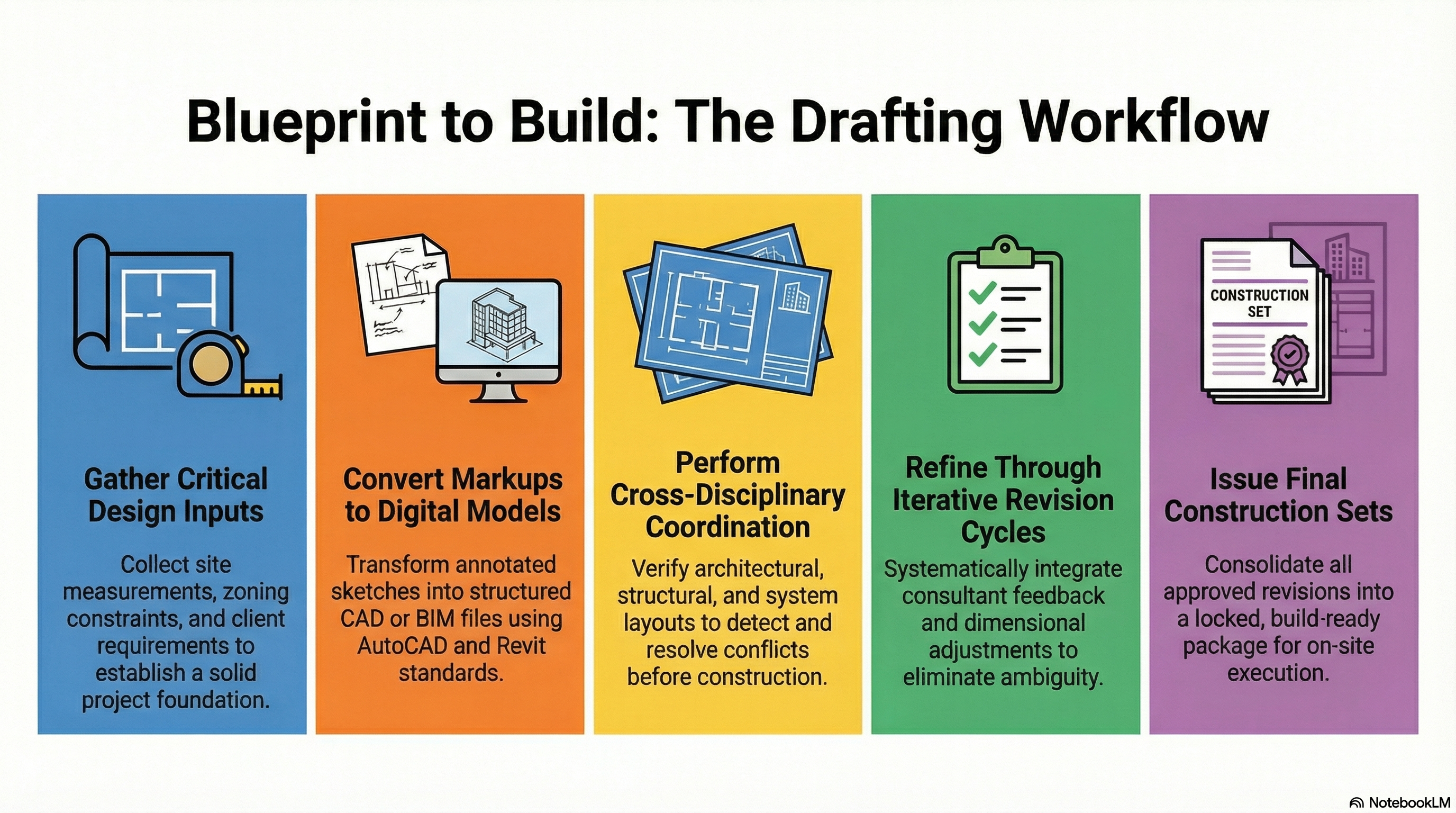
Scope confirmation, data intake, dimensional structuring, technical detailing, coordination review, and controlled revisions define the core stages of Architectural Drafting. The workflow starts by clarifying project intent, constraints, and performance requirements, then organizing grids, levels, and reference systems to create measurable spatial logic.
Detailed junctions, build tolerances, and material transitions are resolved before documentation is cross-checked for consistency between plans, sections, and elevations, ensuring the final drawing set supports real construction sequencing and minimizes site misinterpretation.
Receiving design inputs is the stage where Architectural Drafting begins by collecting concept sketches, site measurements, zoning constraints, and client requirements. At this point, alignment with International Code Council guidelines and coordination expectations are clarified. Accurate base data prevents dimensional conflicts, reduces revisions, and establishes a structured foundation for reliable, construction-ready documentation.
Converting markups to CAD or BIM transforms annotated sketches into structured digital drawings within Architectural Drafting. During this stage, redlines, dimensional corrections, material notes, and coordination comments are interpreted and embedded into coordinated models using standards aligned with AutoCAD and Revit. Clear revision notes, scaled references, and updated design decisions are essential to ensure accuracy and downstream consistency.
Cross-disciplinary verification ensures Architectural Drafting outputs remain consistent between architectural layouts, structural frameworks, and building systems before formal issue. During this stage, grids, levels, penetrations, and dimensional tolerances are examined to detect conflicts early. Documentation clarity typically aligns with standards promoted by the International Organization for Standardization, strengthening accuracy. This process minimizes rework, prevents sequencing errors, and protects construction timelines from avoidable disruptions.
Iterative refinement ensures drawings evolve into fully coordinated, issue-ready documents, making this a defining stage of Architectural Drafting. During this phase, client feedback, consultant inputs, dimensional adjustments, and constructability concerns are systematically integrated. Each revision generates updated sheets, tracked changes, and clarified annotations that eliminate ambiguity.
Clear redlines, confirmed decisions, and defined scope boundaries are essential inputs, preventing uncontrolled edits and ensuring the final documentation reflects approved intent with measurable accuracy and accountability.
The finalized issue package represents the point where Architectural Drafting transitions from coordination to execution. At this stage, all approved revisions are consolidated, sheet indexes are verified, dimensions are locked, and annotation hierarchies are standardized for clarity.
The output is a structured, build-ready construction set that contractors rely on for pricing, sequencing, and on-site decision-making. Achieving this requires confirmed design approvals, coordinated consultant inputs, resolved detailing conditions, and clearly defined specifications to ensure the documentation supports efficient, conflict-free construction delivery.
AutoCAD, Revit, and ArchiCAD are primary platforms used in Architectural Drafting. AutoCAD supports precise 2D documentation and detailing, Revit enables coordinated 3D modeling with data-rich elements, and ArchiCAD streamlines BIM-based workflows. Together, these tools improve drawing accuracy, coordination visibility, and documentation efficiency across complex construction projects.
Architectural Drafting supports coordination by aligning spatial layouts with structural loads and MEP routing before construction begins. Through layered documentation and shared reference grids consistent with Building Information Modeling principles, it clarifies ceiling voids, shaft dimensions, and penetration zones. This reduces clashes, prevents late-stage redesign, and enables synchronized sequencing across trades.
Architectural Drafting timelines are shaped by project complexity, coordination layers, and decision speed rather than square footage alone. Clear inputs and defined approval paths can significantly compress delivery windows. Typical expectations include:
Initial structuring phase; organizing grids, levels, and drawing hierarchy once validated inputs are received.
Technical development phase; resolving details, dimensions, and constructability logic.
Coordination window; integrating consultant feedback and aligning documentation.
Final issue preparation; consolidating revisions into an execution-ready construction set.
Incomplete design inputs, late scope changes, dimensional discrepancies, and cross-discipline coordination gaps are the most common challenges in Architectural Drafting and how they are managed determines project stability. These issues are addressed through structured input validation, clearly defined revision protocols, layered drawing audits, and systematic cross-checking between plans, sections, and details. Maintaining documented decisions and approval checkpoints minimizes ambiguity, while early constructability assessments help prevent downstream rework and schedule disruption.
Clear documentation frameworks transform complex design ideas into measurable, executable systems through Architectural Drafting. By organizing spatial logic, defining material transitions, and standardizing sheet hierarchies aligned with Building Information Modeling methodologies, teams reduce ambiguity before construction begins.
This structured approach enhances bidding accuracy, improves trade sequencing, and strengthens communication between designers, engineers, and contractors across evolving project phases.