

Navigating the commercial realities of offshore construction requires more than simply signing a robust agreement and hoping for seamless execution. When managing complex operations, the gap between what is written in the contract and what occurs during execution can quickly become a source of intense commercial friction.
Construction Contract Administration Services in Australia help ensure project activities remain aligned with contractual obligations. Success is rarely achieved through perfect documentation alone; it depends on consistent oversight, accurate contract management, and proactive decision-making that protects profit margins, reduces disputes, and maintains project momentum.
What construction contract administration services actually cover?
Understanding the scope of these services is the first step toward regaining control over your commercial baselines. The focus is never solely on legal interpretation; it bridges the gap between site realities and commercial entitlement. A robust administration framework ensures that every operational event, from minor delays to major scope changes, is captured, assessed, and formally addressed according to the agreed terms.
The difference between contract administration, contract management and project administration
Contract administration focuses primarily on the rigorous execution of the agreed terms, acting as the procedural backbone of the project. While contract management might deal with the broader commercial relationship and negotiation phases, administration is strictly about compliance, notices, and record-keeping during execution. Difference between a Project Manager and a Contract Administrator
Where these services sit between procurement, delivery and commercial control
These services function as the critical filter between what Procurement initially buys and what the Delivery team actually builds. When a Fabrication Yard experiences delays, the contract administrator ensures the commercial impact is isolated and managed before it infects the wider project budget.
They provide the necessary data and compliance checks that allow commercial leaders to make informed decisions. This positioning ensures that operational changes, such as adjustments to a Subsea Installation methodology, are immediately translated into commercial risk profiles.
A stage-by-stage view of construction contract administration services
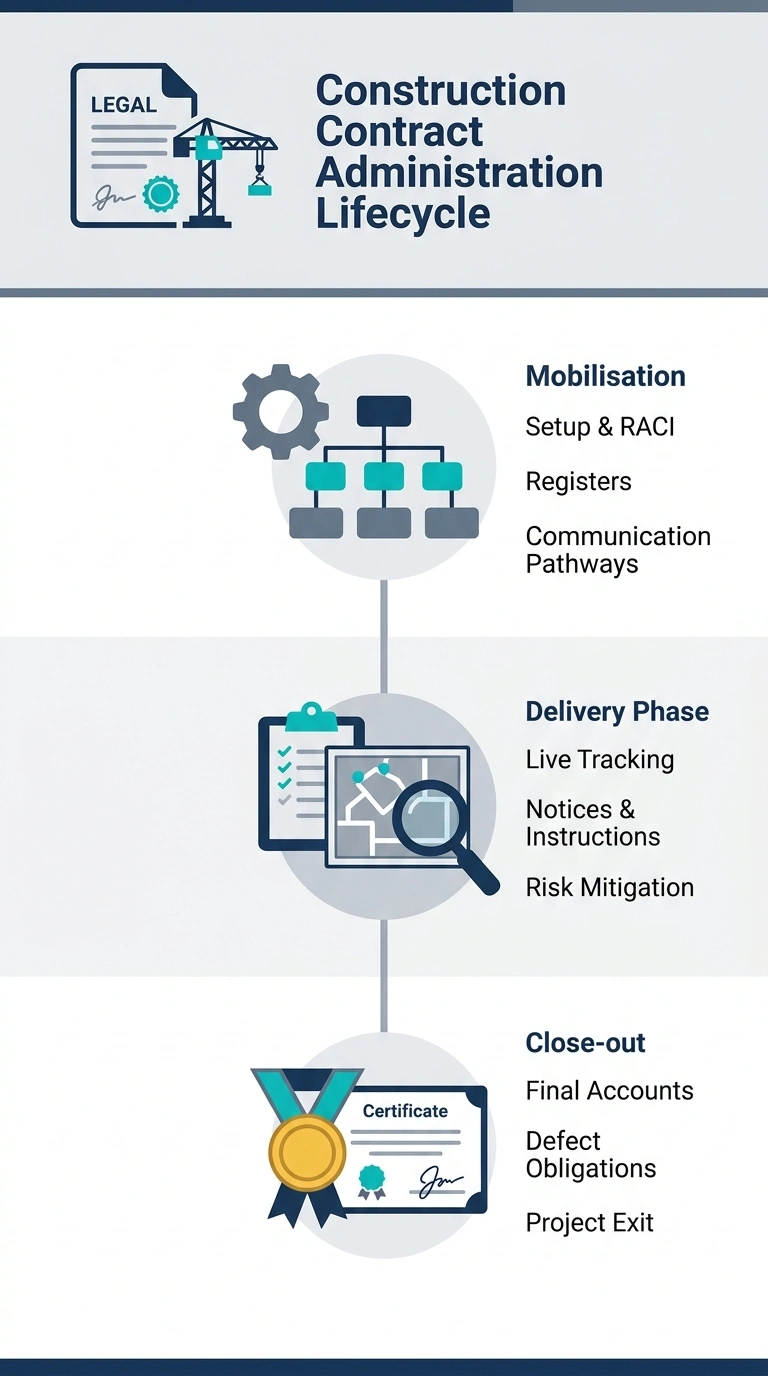
Effective administration is not a reactive process that begins when a dispute arises; it is a continuous, phased discipline. Each stage of the project lifecycle demands a different focus, from establishing the initial guardrails to managing the final commercial close-out.
Mobilisation: setting up registers, responsibilities and communication pathways
During mobilisation, establishing registers for variations, delays, and communications is essential to protect contractual rights. Clear communication pathways help ensure notices remain valid, while a well-defined RACI matrix clarifies responsibilities and ensures critical project information is consistently reported to the contract administration team.
Delivery phase: tracking notices, instructions, claims and contract events
During the delivery phase, effective contract administration requires continuous monitoring of site instructions, daily records, weather impacts, and contract events. Proactively tracking potential variations, notices, and claims helps identify risks early, prevent disputes, and maintain commercial control throughout project execution.
Close-out: final accounts, defect obligations and contractual completion records
Close-out phase requires methodical reconciliation of commercial threads developed throughout the project, relying on meticulous records from delivery to support final account negotiations. Managing defects liability periods and securing completion certificates after commissioning demands strict adherence to contractual exit criteria.
Core functions within construction contract administration services
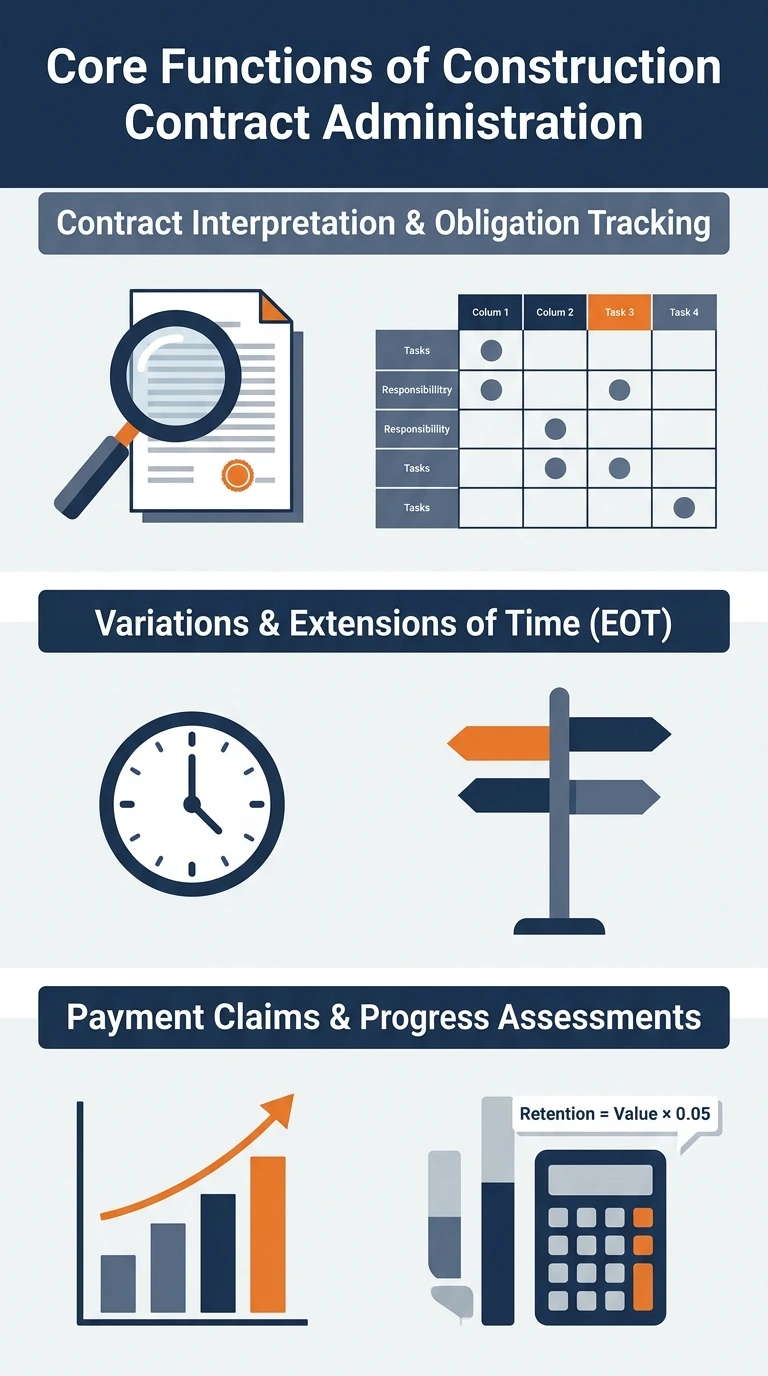
To truly appreciate the value of these services, one must look at the specific, daily functions that keep a project commercially viable. These are the mechanical tasks that, when executed flawlessly, protect the project’s bottom line.
Contract review, interpretation and obligation tracking
Construction Contract Administration Services in Australia involves translating complex legal contracts (FIDIC/LOGIC or bespoke) into actionable execution matrices. It tracks obligations like Marine Warranty Surveyor sign-off before critical lifts, preventing uninsured losses, delays, and milestone risks across projects efficiently overall.
Variations, extensions of time and contractual notices
Managing changes is arguably the most critical aspect of the administrator’s role, requiring a delicate balance of operational understanding and contractual rigidity.
“In complex offshore environments, the failure to submit a timely notice is not merely an administrative oversight; it is an active forfeiture of commercial rights.”
When the delivery team requests additional time, the administrator must ensure the request is perfectly aligned with the contract’s extension of time mechanics. Here is a breakdown of how variations are typically categorized and managed:
- Client-directed scope changes requiring immediate pricing.
- Constructive variations arising from ambiguous site instructions.
- Design development changes that exceed the original intent.
- Statutory changes affecting execution methodologies.
Payment claims, progress assessments and supporting documentation
Ensuring positive cash flow requires rigorous assessment of payment claims against verified physical progress, aligning milestones with field reports to prevent overpayment, safeguard contractual leverage, and support effective defect correction while maintaining strict financial and documentation control across the project lifecycle.
RetentionAmount=ContractValue×0.05
Record-keeping, correspondence control and audit-ready files
In the realm of contract administration, an unrecorded event is an event that never happened. Maintaining an audit-ready file involves linking every piece of correspondence to specific contractual clauses and project events. This disciplined approach is what separates successful claims resolution from costly arbitration proceedings.
The documents that make or break contract administration
The strength of your commercial position relies entirely on the quality and accessibility of specific documents. Contract administration is inherently document-heavy, and knowing which records carry the most weight is essential.Step-by-Step Guide on Contract Administration Process
Head contracts, subcontracts, scopes of work and annexures
The hierarchy of documents dictates how conflicts between specifications and drawings are resolved. A skilled administrator constantly cross-references the EPC / EPCI Contracts with lower-tier subcontracts to ensure risk is adequately passed down. Ambiguities in the scope of work are the primary breeding ground for disputes, making early clarification of annexures a critical administrative task.
Program updates, RFIs, site instructions and variation registers
Dynamic documents like the project schedule and RFI logs are the pulse of the project’s commercial health. When a site instruction alters the sequence of an Offshore Installation, the variation register must immediately reflect the potential cost and time impacts. Without linking these dynamic documents, assessing the true impact of a delay becomes an impossible task.
Payment schedules, delay notices and completion evidence
Payment schedules and formal delay notices are the ultimate leverage points in any construction contract. If a delay notice lacks the specific evidentiary requirements stipulated in the contract, it will be swiftly rejected. Gathering robust completion evidence is essential for triggering milestone payments and transitioning into the warranty phase.
How contract administration services reduce commercial leakage?
Commercial leakage occurs when minor, unmanaged changes accumulate and gradually erode project profit margins. Implementing strict project controls and disciplined change management ensures every additional effort is identified, documented, and properly compensated throughout the construction administration process in project delivery.
Industry data indicates that projects without dedicated administration experience up to 12% higher rate of unrecoverable costs. A systematic approach to construction contract administration ensures entitlement is preserved and never lost due to procedural negligence, weak controls or poor documentation.
Risk points your contract administrator should catch early
A proactive contract administrator acts as an early warning system, detecting subcontractor deviations from the approved program and signalling potential delay claims. They also scrutinise incoming notices, identifying vague or protective language that may indicate an emerging formal claim strategy.
On an offshore pipeline project in Australia, unexpected seabed conditions identified in early geotechnical data are compared against baseline tender information. The administrator flags discrepancies, applies contract risk allocation rules, and prepares objective frameworks for evaluating extension of time claims.
Construction contract administration for head contractors, subcontractors and principals
The perspective and priorities of contract administration shift depending on where you sit in the contracting chain. For principals, the focus is on cost certainty and ensuring contractors do not exploit ambiguities for financial gain. Head contractors use these services to maximize their upward entitlement while strictly limiting their downward exposure to subcontractors.
Subcontractors, often the most vulnerable, rely on meticulous administration to survive harsh payment terms and secure payment for out-of-sequence works.
| Stakeholder | Primary Administration Focus | Key Risk Area |
|---|---|---|
| Principal | Cost certainty & scope containment | Contractor exploiting ambiguities |
| Head Contractor | Maximizing upstream claims, limiting downstream | Squeezed margins from both sides |
| Subcontractor | Securing timely payments & variation approvals | Harsh payment terms & unfair risk flow-down |
Offshore support in construction contract administration services
Integrating external support into your commercial team can provide a necessary layer of objectivity and specialized expertise. Utilising specialized Offshore Administration Services allows your core team to focus on delivery while experts handle the procedural heavy lifting. This model provides scalable resources that can expand during peak claim periods and contract as the project moves into commissioning.
Offshore contract administration without losing control or compliance
Delegating administrative tasks does not mean losing commercial control over a project. Successful construction contract administration in Australia requires clear boundaries, automated reporting dashboards, and strict adherence to a delegation of authority matrix, ensuring structured governance and controlled execution process.
By maintaining visibility over key performance indicators of the administration team, project leaders can trust the process while retaining authority to make critical commercial decisions. This ensures balanced governance, proactive oversight, and sustained control across complex contract administration environments globally.
Signs you need external construction contract administration services
Recognising when your internal team is overwhelmed is vital to avoid commercial risk. Backlogs of unassessed variations, missed deadlines, and informal site agreements indicate failing controls, while managers focused on paperwork rather than strategy require dedicated support to restore compliance.