
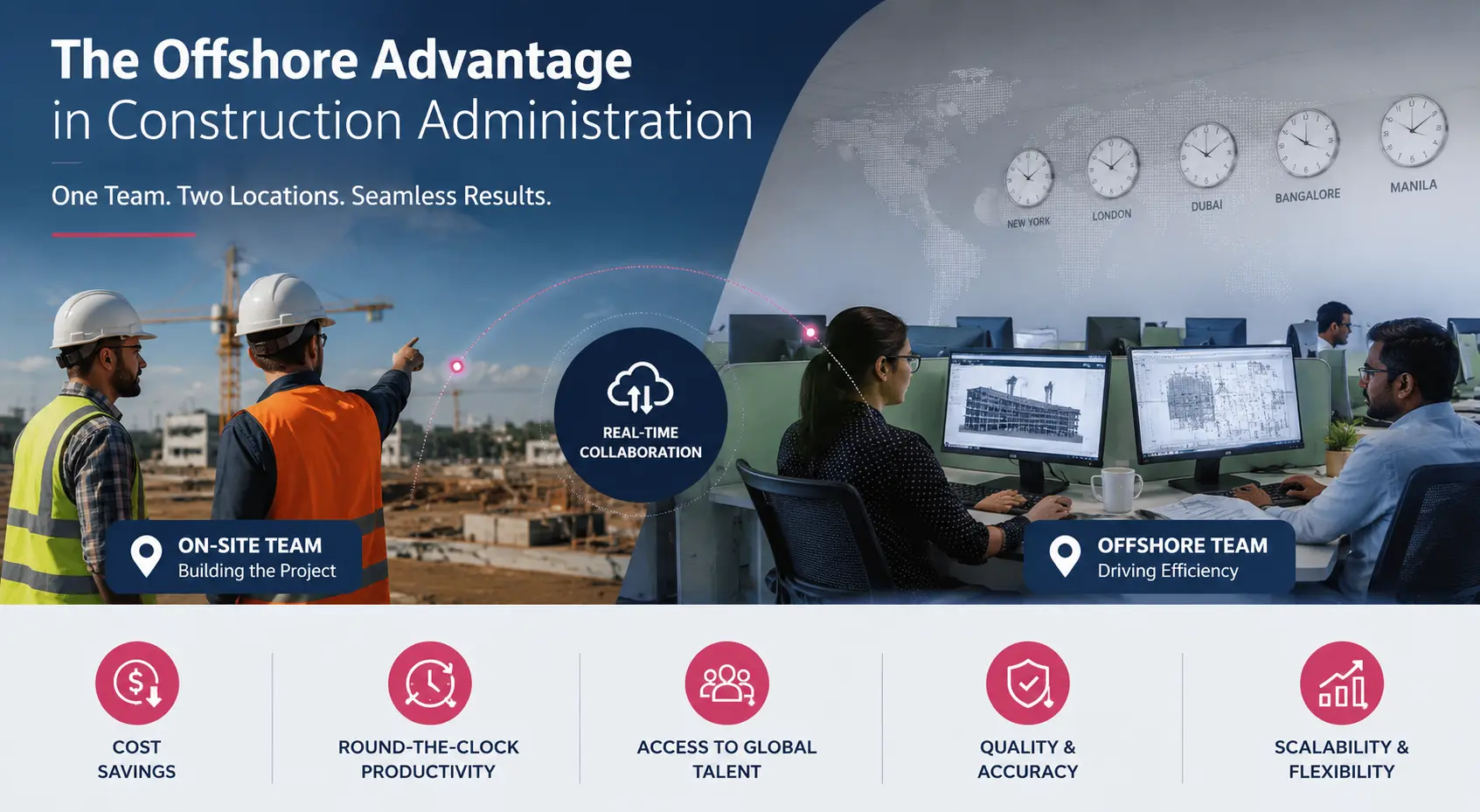
Construction administration is often viewed as a back-office function. In reality, it directly influences project outcomes, contractual compliance, schedule performance, communication quality, and the ability to defend commercial positions when disputes, variations, delays, or scope changes arise.
For organisations managing offshore platforms, subsea pipelines, LNG facilities, marine terminals, offshore wind farms, or EPCI projects, administrative efficiency can significantly affect both operational performance and commercial risk exposure.
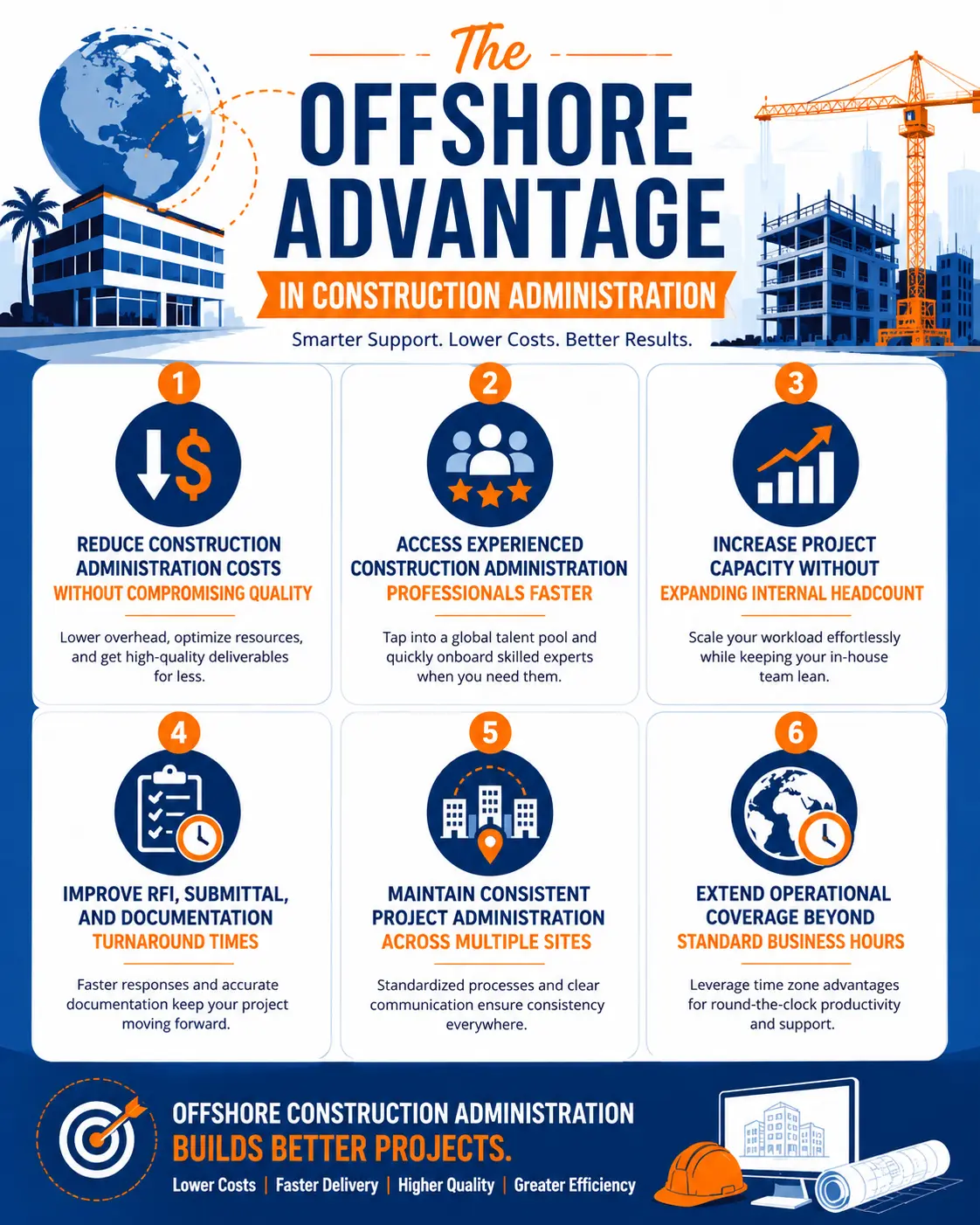
Reduce Construction Administration Costs Without Compromising Quality
One of the most recognised offshore advantages is the ability to reduce administrative expenditure while maintaining structured project controls. Construction administration activities such as document management, correspondence tracking, RFI administration, transmittal processing, submittal coordination, progress reporting, and contract record management often require substantial labour hours but not necessarily physical site presence.
Industry analyses from global engineering and business services markets have consistently shown offshore professional services models delivering labour cost reductions ranging from approximately 30% to 70%, depending on location, complexity, governance requirements, and workforce structure. However, the actual value is rarely created by labour arbitrage alone.
| Construction Administration Activity | Typical Offshore Suitability | Quality Control Requirement |
|---|---|---|
| RFI Tracking | High | Moderate |
| Submittal Management | High | High |
| Document Control | Very High | High |
| Contract Correspondence Logs | Very High | Moderate |
| Site Inspection Activities | Low | Very High |
Cost reduction should never be evaluated independently from risk. A lower-cost administration team that introduces document errors, delayed notices, poor version control, or incomplete records may ultimately increase claim exposure and commercial risk. The objective is not the lowest-cost resource; it is the most efficient and reliable administrative operating model.
Access Experienced Construction Administration Professionals Faster
Many construction organisations face recruitment challenges when project workloads increase unexpectedly. Large offshore developments, shutdown campaigns, brownfield modifications, and EPC contract awards often create immediate demand for contract administrators, document controllers, project coordinators, planners, and commercial support personnel.
Offshore administration models provide access to broader talent pools without the delays associated with local recruitment cycles. This can be particularly valuable when project mobilisation schedules leave limited time for building internal administrative capability. The ability to deploy trained resources within weeks rather than months can significantly improve project readiness.
In practice, the speed advantage becomes most noticeable during project start-up phases when contract registers, document numbering systems, approval workflows, communication matrices, and reporting structures must be established quickly to avoid administrative bottlenecks later in execution.
For organisations seeking scalable Offshore Administration Services, the key consideration is not simply resource availability but whether personnel understand engineering documentation structures, contract deliverables, project controls processes, and construction execution requirements.
Increase Project Capacity Without Expanding Internal Headcount
Construction organisations frequently encounter a capacity challenge rather than a capability challenge. Internal teams possess the required expertise but lack sufficient bandwidth to support multiple concurrent projects. Offshore administration can provide additional capacity while allowing senior project personnel to focus on higher-value technical, commercial, and stakeholder responsibilities.
Administrative workload often increases disproportionately as project portfolios expand. Every additional project introduces new RFIs, submittals, transmittals, correspondence records, meeting minutes, progress reports, and contractual notices. Without additional support, administrative responsibilities may begin consuming time intended for project management and decision-making.
A common misconception is that offshore teams replace internal personnel. In successful implementations, offshore resources typically complement internal teams by managing process-driven activities while project leadership retains control of technical reviews, commercial decisions, and client-facing responsibilities.
- Manage growing project portfolios without proportional headcount increases.
- Reduce administrative overload on project managers.
- Improve workflow consistency across multiple projects.
- Create flexible resource capacity during workload peaks.
- Support business growth without major fixed-cost expansion.
Not Sure If Offshore Construction Administration Is Right for Your Project?
Every project has different contract risks, documentation requirements, and resource challenges. Discuss your situation with our team and explore practical options before making a decision.
Improve RFI, Submittal, and Documentation Turnaround Times
Slow administrative processes frequently create hidden project inefficiencies. Delayed RFIs can affect engineering decisions. Slow submittal processing can influence procurement schedules. Incomplete document control can create uncertainty regarding approved revisions, technical requirements, and contractual obligations.
Offshore administration teams can improve turnaround times by providing dedicated support focused on workflow management rather than balancing multiple competing project responsibilities. Faster processing does not necessarily mean faster approvals; however, it often means faster routing, tracking, escalation, and follow-up activities.
Consider an offshore platform modification project where multiple vendors submit technical documentation for review. If submittal tracking is inconsistent, engineering comments may be delayed, procurement activities can be affected, and fabrication schedules may experience avoidable disruption. In contrast, a structured administration process can provide visibility into outstanding reviews before delays become critical.
Maintain Consistent Project Administration Across Multiple Sites
Construction organisations operating across multiple regions often encounter variations in administrative practices. Different projects may use different document registers, correspondence procedures, approval workflows, reporting formats, and filing structures. Over time, these inconsistencies can make portfolio-level management increasingly difficult.
An offshore administration model can support standardisation across projects by applying common processes, templates, document control procedures, and reporting methodologies. This creates greater visibility for leadership teams and reduces the risk of critical information being overlooked.
Consistency becomes particularly important when projects involve multiple contractors, joint ventures, marine spreads, fabrication yards, and client representatives. Administrative alignment helps ensure that contractual obligations, reporting requirements, and project records remain accessible and traceable throughout the project lifecycle.
Extend Operational Coverage Beyond Standard Business Hours
Time-zone advantages represent one of the most practical benefits of offshore construction administration. Rather than limiting project support to local business hours, organisations can create near-continuous administrative coverage through strategically aligned offshore teams.
This approach can be especially valuable for multinational projects involving stakeholders across Australia, Asia, the Middle East, Europe, and North America. Activities such as document processing, report preparation, database updates, workflow monitoring, and correspondence management can continue while local teams are offline.
The result is often a shorter administrative cycle rather than longer individual working hours. Project teams arrive each morning with updated registers, processed documentation, and completed administrative tasks ready for review.
Which Construction Administration Functions Can Be Managed Offshore?
Not every construction administration activity should be transferred offshore. The most suitable functions are generally process-driven, documentation-focused, and governed by clearly defined procedures. Activities requiring continuous physical site presence, direct field supervision, or immediate operational decision-making typically remain onshore.
Functions commonly managed offshore include document control, contract registers, RFI administration, submittal tracking, transmittal management, meeting minutes, progress reporting support, project data management, records administration, variation logs, correspondence tracking, schedule reporting assistance, and compliance documentation management.
- Document control and revision management.
- RFI and submittal administration.
- Contract correspondence tracking.
- Variation and change registers.
- Progress reporting support.
- Project records management.
Many organisations searching for Construction Administration services initially focus on document control. However, the broader value often emerges when multiple interconnected administrative functions are integrated into a coordinated support framework.
What Makes an Offshore Construction Administration Team Successful?
Successful offshore administration programmes depend far more on governance than geography. The strongest teams typically operate under clearly defined procedures, documented workflows, measurable performance expectations, and structured communication channels.
Construction administration involves more than processing paperwork. Teams must understand how project records connect to contractual rights, schedule performance, quality requirements, payment processes, and claim defensibility. A technically correct document that is issued late may still create commercial exposure.
One frequently overlooked issue involves notice requirements. In many offshore construction contracts, entitlement to additional time or cost may depend on timely notification. If correspondence management processes fail to identify notice deadlines, a valid contractual entitlement may become more difficult to enforce. This demonstrates why administrative competence directly affects commercial outcomes.
Successful teams generally share several characteristics:
- Clear governance structures.
- Defined escalation pathways.
- Construction industry knowledge.
- Contract administration awareness.
- Strong document control discipline.
- Reliable communication protocols.
How to Evaluate an Offshore Construction Administration Provider
Selecting an offshore provider requires more than comparing hourly rates. Organisations should assess industry experience, quality assurance processes, security controls, training programmes, communication capabilities, technology platforms, and operational resilience.
Evaluation should also consider whether the provider understands engineering and construction environments. Administrative support for offshore construction projects differs significantly from generic business process outsourcing because documentation structures, contractual obligations, technical review cycles, and project controls requirements are substantially more complex.
| Evaluation Area | Why It Matters |
|---|---|
| Industry Experience | Reduces onboarding time and errors |
| Document Control Expertise | Protects information integrity |
| Contract Awareness | Supports compliance obligations |
| Security Frameworks | Protects sensitive project data |
| Scalability | Supports future growth requirements |
It is also important to evaluate transition planning. Even highly capable providers require structured onboarding, process mapping, responsibility allocation, workflow testing, and performance monitoring before administrative benefits can be fully realised.
Looking for Reliable Offshore Construction Administration Support?
Whether you need document control, RFI management, project coordination, or scalable administration support, we can help you identify the most effective offshore delivery model for your business.
Is Offshore Construction Administration the Right Fit for Your Business?
Offshore construction administration is not automatically the right solution for every organisation. The suitability depends on project complexity, portfolio size, internal processes, technology maturity, communication requirements, contractual obligations, and management expectations.
Businesses managing multiple projects, experiencing resource constraints, facing recruitment challenges, or seeking greater administrative consistency often achieve the strongest outcomes. Conversely, organisations with highly informal processes may discover that offshore implementation exposes underlying workflow weaknesses that should be addressed first.
The most effective approach is usually neither fully offshore nor fully internal. Many successful construction organisations adopt a hybrid model where strategic decision-making, client engagement, commercial leadership, and field execution remain local while structured administrative functions are supported offshore.
Ultimately, the offshore advantage in construction administration is not simply about reducing costs. It is about creating a scalable, disciplined, and resilient administrative capability that strengthens project controls, improves information management, supports contractual compliance, and enables project teams to focus on delivering successful construction outcomes.